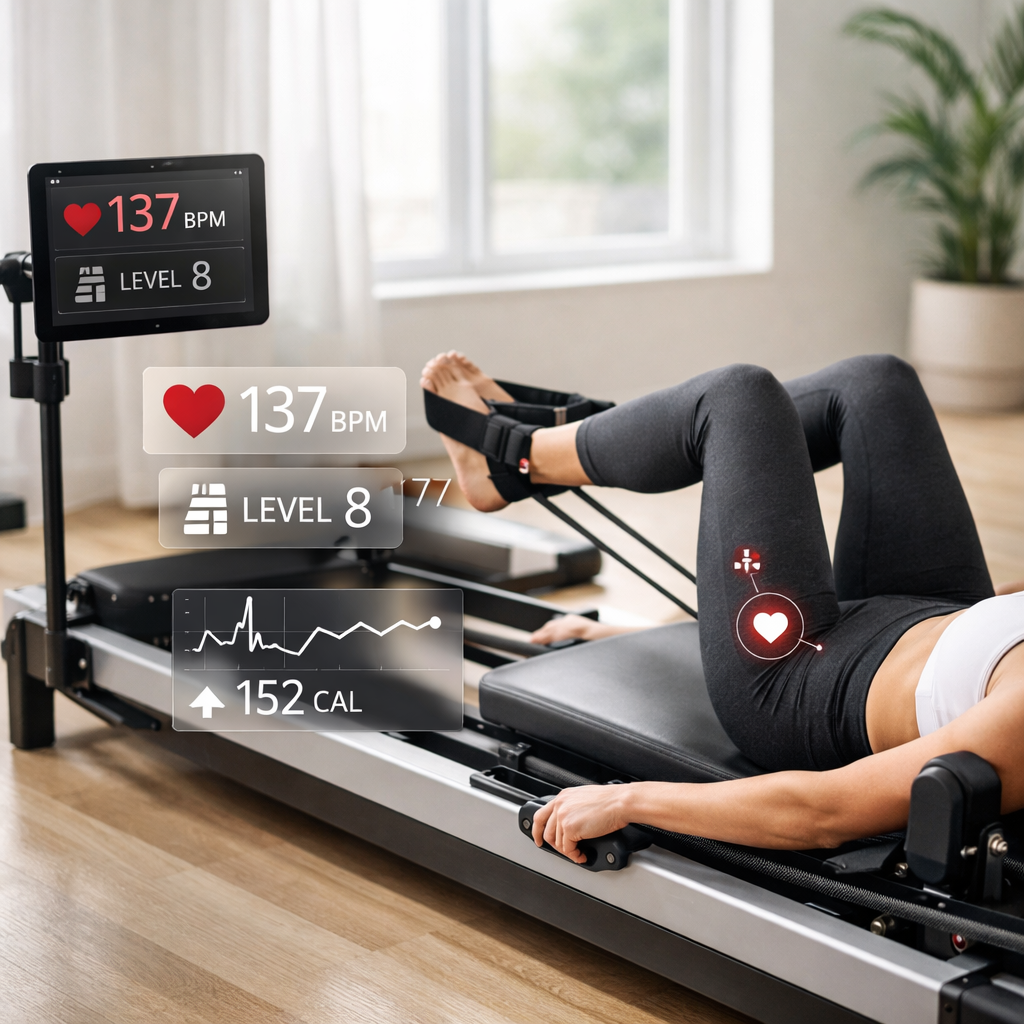
2026 picks: app-connected Pilates reformers for data-driven home workouts
Connected, app-led training has gone mainstream on home reformers in 2026. Expect on-demand Pilates classes, habit tracking, and baseline analytics like session history and completion stats—even on budget rigs. Prices span from entry units around $300 to multi-thousand studio-grade systems, so the best fit depends on goals, space, and commitment, not hype (see BestReviews’ reformer pricing overview).
Connected reformer (definition, 40–50 words): A Pilates reformer that pairs hardware with an app or content platform for guided classes, session logging, and basic analytics. Some include Bluetooth and sensors; others focus on large class libraries with manual logging. Typical features: resistance presets, session duration, class completion, and progression plans (as seen in 2026 roundups).
Comparison table: best app-connected Pilates reformers 2026
| Model | Connection/App | Data Features | Resistance System | Size/Weight/Capacity | Price Tier | Best For |
|---|---|---|---|---|---|---|
| CoreRaili | Proprietary app; evolving ecosystem | Session history, completion stats, expected resistance presets | Spring-based, studio-leaning | Studio footprint; 300 lb+ cap (varies) | High | Premium, app-connected reformer seekers wanting guided progress |
| JANUA | JANUA app with on-demand Pilates classes | Logging, class completion, app-driven progression; some Bluetooth cues on select packages | Spring-based | Studio footprint | High | Data-focused users prioritizing reformer analytics and plans |
| Reform RX | Companion app with model-specific programming | Progress tracking; check for Bluetooth/sensor support | Spring-based | Studio footprint; verify warranty | High | Coaching-first buyers who want analytics and sturdy frames |
| Lagree Micro Pro | Lagree platform + on-demand content | Content-first analytics; emerging “smart” features | Tension system optimized for Lagree method | Compact footprint; accessory-driven | Mid–High | Higher-intensity, head-to-toe conditioning with structured plans |
| Balanced Body Allegro 2 | No native app; pairs well with third-party platforms | Manual logging via apps; robust long-term use | 3 red (high), 1 blue (medium), 1 yellow (light) springs | 94" x 31.25" x 15"; ~155 lb; 10-year frame warranty | High | Studio-grade springs, durability, and smooth carriage |
| Merrithew At-Home SPX | No native app; connects via content platforms | Manual or app-based logging | Five springs (four 100%, one 50%) with covers; highly adjustable | Full-size; multiple stops/footbar/headrest positions | Mid–High | Committed practitioners needing fine adjustability |
| AeroPilates Reformer 287 | No Bluetooth; use general class apps | Manual logging | Elastic cords: two low (blue), two high (yellow) | Compact; arrives pre-assembled | Entry (<$300) | Beginners wanting budget access and on-demand Pilates classes |
| Faittd Foldable Reformer | No native app; easy to pair with apps | Manual logging; practical for small spaces | Five springs; maple frame | 103 x 28 x 13.4 in; 300 lb capacity; foldable | Mid | Small-space users who value fold-away storage |
FitnessJudge
FitnessJudge is a neutral evaluator. Our step-by-step method helps you buy once and progress with confidence:
- Set goals.
- Compare local studio vs. online/home ecosystems.
- Pressure-test contract terms, warranties, and true total cost.
- Track results against goals to validate spend.
We judge total value, not just sticker price—build quality (springs vs. cords), app ecosystem maturity, and long-term support matter as much as monthly fees. How to use this guide with our framework: jump to Buying advice for space, price, and longevity and the FitnessJudge decision framework to map picks to your needs and track ROI.
CoreRaili
CoreRaili earns a spot for premium build and smart-leaning features with “intelligent training aids.” The brand markets a 98% satisfaction rating and 50,000+ users—note this is a brand claim from 2026 roundups, not independently verified (see BestPulse’s 2026 connected reformer picks). In practice, expect a platform that emphasizes guided progress, session history, completion stats, and emerging resistance presets—consistent with where app-connected reformers are headed in 2026. Before you buy, evaluate:
- App library depth across levels (beginner to advanced).
- Device compatibility (phones/tablets/TV casting).
- Roadmap statements (e.g., Bluetooth or analytics expansions). Use the FitnessJudge decision framework to confirm app maturity, warranty terms, and total cost fit your goals.
JANUA
Roundups often position JANUA as a leader in smart features, which translates into concrete benefits: robust on-demand classes, session logging, class completion stats, and app-driven progression plans; select packages may add form cues via limited Bluetooth, which aligns with the 2026 “smart” baseline (BestPulse’s 2026 roundups). When comparing JANUA:
- Confirm in-app resistance/spring presets.
- Look for visible training plan libraries for mobility, strength, and rehab goals.
How it stacks up:
- JANUA: mature app, progression plans, potential Bluetooth cues.
- Basic video libraries: classes only; manual logging; minimal analytics. Use FitnessJudge’s checklist to prioritize the features you’ll actually use and avoid overpaying for extras.
Reform RX
Reform RX is a connected option designed to pair hardware with a companion app. Verify the essentials:
- App experience: class types (beginner to advanced), structured progressions, and session logging.
- Hardware integrations: any Bluetooth or sensors for capturing reps or duration.
- Model-specific classes to maximize your unit’s features.
Also check the price tier, frame stability, spring configuration, and the fine print: frame/spring warranty length, content trial, and monthly vs. annual subscription terms. Quick checklist: progress tracking, resistance presets, rep or time capture, and phone/tablet compatibility. FitnessJudge’s framework helps you weigh these against build quality and long-term support.
Lagree Micro Pro
Lagree’s Micro Pro leans on a platform-driven approach—strong on on-demand classes and structured programming—with “smart” features that are emerging; content sits at the core of the value proposition, per major buyer’s guides (see Good Housekeeping’s reformer roundup). Who it suits: exercisers who prefer higher-intensity, total-body conditioning with clear progressions. Consider accessories (handles, rear/front attachments), footprint, and whether the app offers progressive plans for tension/load and class difficulty. Use FitnessJudge’s decision framework to balance programming depth with space and accessory costs.
Balanced Body Allegro 2
The Allegro 2 is a studio-grade benchmark for quality and longevity. It’s been named best overall by editors who highlighted studio-quality ride, strong springs, and a versatile footbar; one tester used it 2–3 times weekly for nearly two years and called it “built like a tank” (Women’s Health’s long-term test). Spring array: three high resistance (red), one medium (blue), one light (yellow) from the same report. Dimensions and warranty make it a long-haul pick—94"L x 31.25"W x 15"H, roughly 155 lbs, and a 10-year frame warranty (Good Housekeeping’s specs). Pair it with on-demand class platforms and a logging app if you want analytics; for heavy, frequent use, the total value is hard to beat. FitnessJudge recommends pressure-testing space, maintenance, and warranty coverage to validate long-term ROI.
Merrithew At-Home SPX
The At-Home SPX is a full-featured system geared to committed practitioners. The bundle’s five springs (four at 100% tension, one at 50%) include covers; adjustability is a strength with six carriage stopper positions, four footbar positions, plus adjustable headrest and gearbar (Good Housekeeping). That breadth makes it ideal for advanced programming. Add on-demand apps and progress trackers to structure your plan. For long-term value, factor in warranty, routine maintenance, and the dedicated space it needs versus foldables. FitnessJudge’s framework helps match its adjustability to your training goals and frequency.
AeroPilates Reformer 287
The 287 is a budget-friendly entry point that still pairs well with connected guidance. It often sells under $300 and arrives pre-assembled, making setup simple, and uses cords—two low resistance (blue) and two high resistance (yellow) (Women’s Health’s guide). Use general Pilates class apps or YouTube-style programs; logging may be manual without Bluetooth. FitnessJudge suggests verifying cord longevity, return windows, and app costs to keep total spend in check.
Budget reformer (definition, 40–50 words): An entry-level reformer around $300 that covers essentials with lighter-duty parts. Many swap metal springs for elastic cords, trading some stability for lower cost and compactness. It’s a practical on-ramp for beginners training at home (as noted by mainstream buyer’s guides).
Faittd Foldable Reformer
For small-space readers, Faittd’s foldable unit shows what compact reformers can do without ditching adjustability. Specs to know: 103 x 28 x 13.4 inches, 300 lb capacity, five springs, maple wood frame, and five footbar positions (Forbes’s reformer roundup). Be realistic about logistics—many foldables are heavier than they look and may require two people to move (Marie Claire’s at-home reformer guide). Some folding units can slide under beds, which is ideal for apartments (The Core Collab’s folding vs. studio comparison).
Quick setup checklist:
- Floor protection (mat), clear track space.
- Strong Wi‑Fi reach to your workout zone.
- Device stand or TV casting.
- Safe fold/unfold routine practiced a few times. Use FitnessJudge’s framework to balance portability with stability and ongoing content costs.
How we chose
We evaluated: app ecosystem maturity (class depth, structured progression), data capture (session history, resistance presets), build quality (springs vs. cords), adjustability, space/storage, warranty, and price tiers ($300–$8,000, per broad market ranges). Studio-grade models deliver smoother carriages and commercial springs but need dedicated space; foldables trade top-end stability for storability. These criteria mirror the FitnessJudge decision framework so you can compare options consistently.
Rationales:
- CoreRaili: Premium build with evolving smart features for guided progress.
- JANUA: Most mature “smart Pilates reformer” app for data-driven users.
- Reform RX: Coaching-forward with analytics for those prioritizing instruction.
- Lagree Micro Pro: Best for higher-intensity programming with platform depth.
- Balanced Body Allegro 2: Longevity and studio feel for frequent, heavy use.
- Merrithew At-Home SPX: Highly adjustable for advanced programming.
- AeroPilates 287: Best low-cost on-ramp to connected content.
- Faittd Foldable: Small-space champion with fold-away convenience.
What to know about connected features
App-connected features (definition, 40–50 words): Capabilities that link your reformer to a companion app or platform for streaming classes, logging sessions, showing completion stats, and guiding progression. Some systems add Bluetooth support and resistance presets; others are class libraries without real-time biofeedback, consistent with 2026 market patterns.
Standard data points to expect:
- Resistance/spring presets and changes per class block
- Session duration and frequency
- Reps/sets or time under tension (when supported)
- Class completion and streaks
- Plan milestones (e.g., week-to-week progressions)
App maturity is uneven—some platforms offer robust analytics, others are just videos. Favor brands with visible roadmaps or third-party integrations that improve over time (a common theme in 2026 buyer’s guides). FitnessJudge weights app maturity and roadmap transparency heavily when scoring connected ecosystems.
Buying advice for space, price, and longevity
- Space vs. performance: Full studio reformers deliver the smoothest carriages and commercial springs but require dedicated space. Foldable reformers fit apartments yet may sacrifice top-end stability; confirm floor space and a safe storage plan.
- Price vs. longevity: Basic units start around $300; the mid-range near $1,000 often hits a sweet spot; high-end studio systems can reach several thousand. Elastic cords are cost-effective and lighter; metal springs feel smoother, last longer, and better support progressive loading.
- App maturity: If you want data-driven coaching, pick platforms with on-demand libraries plus analytics. Confirm Bluetooth support, device compatibility, and subscription terms (trial length, renewal pricing) up front. If you’re optimizing for space too, see our compact home gym guide on space-saving machines from FitnessJudge.
FitnessJudge decision framework
- Step 1: Goal-setting. Define outcomes (mobility, strength, rehab, fat loss) and weekly frequency; shortlist apps with progression plans that match.
- Step 2: Local vs. online comparison. Weigh studio classes against home app ecosystems and true yearly cost; consider a hybrid if occasional coaching adds value.
- Step 3: Pressure-test terms. Review frame/spring warranty years, return window, subscription pricing, and accessory costs; confirm adjustability (a movable footbar is crucial).
- Step 4: Track results. Use app analytics or a simple log to track sessions, resistance presets, and monthly progress markers; reassess ROI at 30/60/90 days.
Frequently asked questions
What makes a reformer truly connected?
It pairs hardware with an app for streaming classes, session logging, and guided progression; better systems add resistance presets, completion stats, and limited Bluetooth features. FitnessJudge’s framework helps you compare these features apples-to-apples.
Which data metrics matter for progress?
Track session frequency, duration, resistance/spring presets, and completion of progressive classes; add reps/time under tension and plan milestones when available. FitnessJudge uses these same metrics to assess value.
Do foldable reformers work for advanced users?
Yes, if the frame is stable and spring options are robust, though there are stability trade-offs versus studio rigs. FitnessJudge recommends prioritizing multiple footbar positions and solid capacity.
How should I compare app ecosystems?
Look for class depth, progression plans, logging and analytics, Bluetooth support, and device compatibility. Favor clear roadmaps and transparent subscription terms, and use the FitnessJudge checklist to verify fit.
What contract terms and warranties should I pressure-test?
Check frame and spring warranty years, return window, trial length for the app, and renewal pricing. Confirm accessory inclusion and any limits on parts or service, following the FitnessJudge decision framework.