How to Choose Compact Rowers for Apartments: Trusted Brands, Fit Tips
A good apartment rower delivers cardio and strength in one, without swallowing your living room. The trick is matching your space, storage style, and noise tolerance to the right resistance system and brand. Below, we break down how to measure for fit, pick the quietest options, and choose trusted compact rower brands that store upright or fold away quickly. You’ll also find FitnessJudge scoring criteria and a practical setup checklist so you can buy once, row often, and stay neighbor-friendly.
Why rowing fits apartment living
Rowing is a high-value, small-footprint solution for home fitness: one machine that hits legs, core, and back while staying low impact and joint-friendly—ideal for a small space cardio routine that doubles as strength work. In compact formats, a rower can replace multiple bulky machines in a small apartment gym without sacrificing training quality, especially for consistent, low-impact workouts that build endurance and power over time (see this apartment-focused buying guide from Merach for context on benefits and space needs) Merach apartment rowing guide. For noise-sensitive buildings, an apartment rower with magnetic or water resistance is typically the safer, quieter pick for shared walls, while still providing a smooth stroke and stable platform for intervals and longer rows small-space rower overview.
Definition: Compact rower — A space-efficient rowing machine designed for small homes and apartments. It uses magnetic, water, air, or hydraulic resistance and prioritizes quiet operation, stable frames, and easy upright or foldable storage to deliver full-body, low-impact training without dominating floor space.
Measure your space and storage
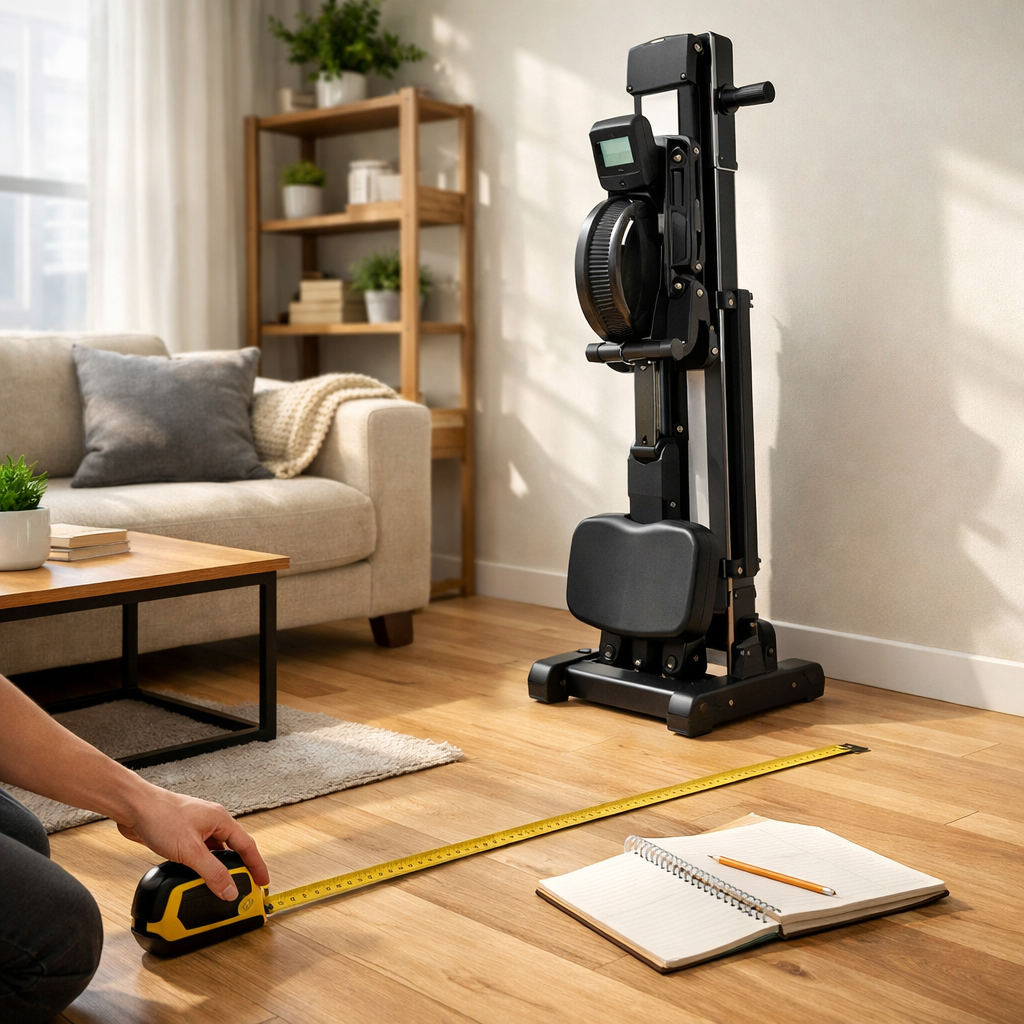
Before you buy, confirm the in-use footprint and where the rower will live when not in use. A practical baseline: plan for roughly 12–14 sq ft in use—about loveseat-sized—so your handle path and knees have room to travel. Many compact models also store vertically or fold to cut length by about 50%, which is a difference-maker in tight hallways or closets foldable rower size guide. FitnessJudge uses this baseline when scoring compactness and daily usability in small spaces.
Follow this simple measuring flow:
- Measure usable length and width for workouts. Add a few inches in front of the footplates and behind the rail for handle travel and safe return.
- Measure your storage area for either upright/vertical storage or a folded footprint.
- Check the path from your entry door to the storage spot for turns, thresholds, and elevator or stair constraints.
A quick way to visualize fit:
| Mode | Footprint guide | What to check |
|---|---|---|
| In use | About 12–14 sq ft (loveseat-sized) | Handle path clearance, knee travel, ceiling height if you’re tall |
| Upright/vertical | 2–3 sq ft on the floor; height near machine length | Wall clearance, ceiling height, stability on a mat |
| Folded (rail hinge) | Length reduced by roughly 50% | Locking latch quality, wheels for rolling to a closet |
Tip: Many foldable rowing machines halve their floor length, which can be the difference between “barely fits” and “works every day” in a studio layout foldable rower size guide.
Choose the right resistance type
Pick resistance based on noise, feel, price, and maintenance. Here’s the short course:
- Magnetic: Smooth, near-silent glide with adjustable resistance; typically the best bet for shared walls and late-night sessions.
- Water: Natural, fluid feel and a soothing swoosh; usually quieter than air and blends nicely into living spaces.
- Air: Highly responsive and popular for performance training, but generally louder and often larger—less ideal for neighbors and thin walls rowing machine buyer’s overview.
- Hydraulic: The most compact and budget-friendly, but the stroke can feel less natural and heat can affect resistance over longer sessions.
Decision rule of thumb:
- Quiet + natural feel = water or magnetic
- Budget + smallest footprint = hydraulic
- Performance + interval work = air or premium magnetic
Definition: Magnetic resistance — A rowing mechanism that uses magnets to create drag on a flywheel. It provides smooth, consistent tension across the stroke and is typically whisper-quiet, making it a top choice for apartments and shared living spaces. In FitnessJudge’s apartment scoring, magnetic systems generally earn the highest quiet-operation marks.
Plan your storage style
For apartments and condos, vertical storage dramatically reduces the floor footprint and speeds up your setup routine. Compared with mid-rail folding systems, upright-storage designs often preserve structural integrity better and feel more “one-piece” under hard strokes. WaterRower’s hardwood models, for example, tip up for vertical storage and blend more like furniture than gym kit, which helps them live in shared rooms without visual clutter compact rower storage insights. If you need to cut length specifically, some foldable rowers hinge the rail to save about half the length—handy for narrow closets and alcoves foldable rower size guide. In our reviews, FitnessJudge typically favors upright storage for faster daily setup and fewer moving joints under load.
Prioritize comfort and build quality
A compact rower still has to feel good—or it won’t get used. Look for a stable rower with a smooth rail, supportive seat, and a handle that doesn’t strain wrists or forearms during intervals. Even in small frames, a solid build should let you sprint without wobble. When you test or evaluate reviews, confirm:
- Seat travel length and smoothness across your full stroke
- Footplate fit and adjustability for your shoe size
- Handle ergonomics and grip comfort
- Rail alignment and overall frame rigidity
- Weight capacity appropriate for all users in the home These checks drive FitnessJudge’s user-experience and build-quality scores.
Balance noise with training goals
In apartments, the best quiet rowing machine options tend to be magnetic or well-designed water resistance systems; air rowers generally run louder and larger, suiting garages or dedicated rooms. Practical noise-control tips:
- Use a dense mat under the machine to dampen vibration and protect floors.
- Save high-intensity intervals for reasonable hours.
- Prefer headphones over onboard speakers; stream classes quietly. FitnessJudge weights neighbor impact heavily for apartment picks.
Verify warranty, service, and delivery
Ownership matters as much as first impressions. Warranty coverage varies widely by brand and price tier, and premium rowers often pair stronger frames with longer, more comprehensive parts/electronics coverage; some also require ongoing content subscriptions (Hydrow Wave, for example, is about 30% smaller than Hydrow’s flagship and pairs with a membership around $44 per month) foldable/apartment picks with warranty notes. Before purchase, confirm:
- What’s covered and for how long (frame vs parts vs electronics)
- Availability of local or in-home service in your area
- Delivery to your apartment unit (stairs/elevator constraints)
- Return window and return shipping costs
- Mounting hardware or wall kits if planning vertical storage FitnessJudge factors warranty strength, service access, and delivery clarity into overall value.
Definition: Warranty — A manufacturer’s written guarantee covering defects in materials or workmanship for a set time. For rowers, coverage typically separates frame, parts, and electronics; longer terms often signal higher build confidence and lower total cost of ownership.
Trusted brands for compact rowers
These brands align well with apartment-focused criteria FitnessJudge emphasizes: quiet operation, compact storage, and stable builds.
- Hydrow (Wave/Arc): Smart, apartment-friendly magnetic rowers with guided classes; the Wave is notably smaller than Hydrow’s flagship and supports vertical storage via an accessory, and Hydrow’s membership runs about $44/month apartment-focused foldable picks. Hydrow’s Arc has also been highlighted as a top home choice for realistic on-water feel Hydrow’s home picks.
- Concept2: Performance standard with responsive air resistance; separates into two pieces and can store vertically; renowned durability.
- WaterRower: Wooden, water-based units with a quiet, natural feel; tip up for elegant vertical storage that blends with furniture.
- Life Fitness / Body‑Solid: Commercial-style stability in smaller footprints; good picks if you want a planted, long-lasting frame without complex tech.
- Merach / Sunny Health & Fitness: Value leaders with compact magnetic and hydraulic options (Merach leans smart/quiet; Sunny covers water, magnetic, and hydraulic with vertical-fold and wheeled storage) Sunny’s rower lineup.
Quick-compare snapshot:
| Brand | Resistance type(s) | Storage style | Notable apartment perk | Est. ongoing costs |
|---|---|---|---|---|
| Hydrow (Wave/Arc) | Magnetic | Upright with accessory | Quiet, coached workouts; smaller Wave frame | Membership around $44/mo |
| Concept2 | Air | Two-piece split / vertical | Proven durability; easy breakdown | None required |
| WaterRower | Water | Upright | Furniture-grade looks; soothing noise profile | None required |
| Life Fitness / Body‑Solid | Magnetic/Air/Water (varies by model) | Upright or fold (varies) | Commercial build quality | None required |
| Merach | Magnetic | Fold or upright (accessories vary) | Budget-friendly smart features | Optional app |
| Sunny Health & Fitness | Hydraulic/Magnetic/Water | Vertical fold/upright | Broad range, very compact options | None required |
FitnessJudge scoring criteria
FitnessJudge uses the following criteria when evaluating compact rowers for apartments:
- Training efficacy: Stroke quality, resistance range, and interval support that scale from easy rows to sprints.
- Quiet operation: Perceived dBA, flywheel/rail noise, and vibration control; neighbor impact through floors/walls.
- Storage and footprint: In-use vs upright/folded size, setup speed, portability (wheels, weight).
- Build quality: Frame stability, rail alignment, component longevity, and warranty strength.
- User experience: Seat comfort, handle/footplate ergonomics, display/app usefulness.
- Value: Price-to-features, hidden costs (subscriptions, accessories), and expected durability.
Example mapping to apartment profiles:
| Model/profile | Training efficacy | Quiet operation | Storage & setup | Build quality | UX & value |
|---|---|---|---|---|---|
| Budget beginner (compact hydraulic) | Basic endurance; limited intervals | Very quiet | Smallest footprint; quick to stash | Light frame; adequate for easy rows | Simple metrics; great price |
| Performance enthusiast (Concept2-style air) | Excellent intervals and pacing | Louder; best in daytime | Splits into two; quick to move | Proven durability | Elite training data; no subscription |
| Smart-class seeker (Hydrow-style magnetic) | Strong intervals with coached programs | Quiet, neighbor-friendly | Upright kit; easy daily setup | Solid frame | Premium classes; ongoing membership |
Practical setup and fit tips
- Measure in-use and storage areas; plan about 12–14 sq ft for rowing and confirm the path from door to storage.
- Choose resistance by priority: quiet/natural feel (magnetic/water); budget/compact (hydraulic); performance (air/premium magnetic).
- Pick storage style: prioritize upright for faster setup and structural integrity; choose foldable if you specifically need to cut length by roughly half.
- Test comfort/build if possible: seat travel and smoothness, footplate fit, handle ergonomics, rail stability under effort.
- Verify warranty, service access, delivery to unit, return costs, and any subscriptions or accessories (e.g., wall kits, mats).
Motivation tech: Smart classes, metrics, and streaks can increase adherence—use them if they help you row more consistently.
Frequently asked questions
How much space do I need to use and store a rower in an apartment?
Plan for about 12–14 sq ft to row comfortably and confirm a path for upright or folded storage; many models store vertically or fold to cut length by roughly 50%. FitnessJudge uses this as a practical apartment baseline.
Which resistance type is quietest for shared walls?
Magnetic rowers are typically the quietest, with well-designed water rowers close behind; air rowers run louder and fit best in dedicated rooms. FitnessJudge usually recommends magnetic first for shared spaces.
Is a foldable rower better than upright storage?
Upright storage is usually faster to set up and preserves structural integrity; foldable rails are great when you specifically need to shrink length dramatically. FitnessJudge generally prioritizes upright for daily-use convenience.
How do I size a rower for my height and weight?
Check maximum user height and seat travel for a full stroke, confirm weight capacity, and ensure footplate and seat comfort; if you can’t test in-store, rely on detailed reviews. FitnessJudge focuses on seat travel vs inseam and true weight limits when assessing fit.
What maintenance keeps a compact rower quiet and durable?
Wipe rails, check fasteners, and use a dense mat to reduce vibration; add water-treatment tablets as directed for water rowers and keep flywheel areas dust-free on magnetic/air models. FitnessJudge’s basics prioritize low noise and long-term reliability.