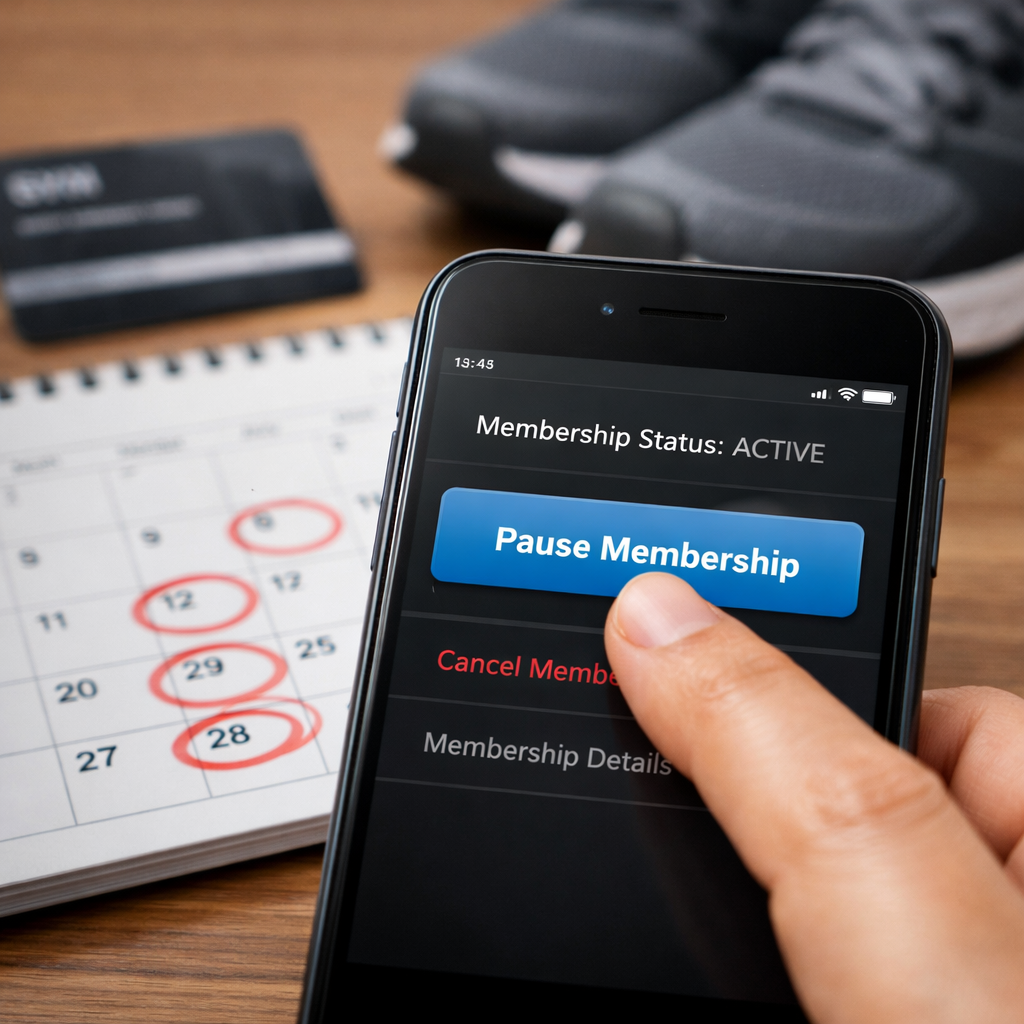
Need A Break? How To Pause Your Gym Membership Legally
Press pause—don’t panic. Most big-box gyms allow you to freeze or suspend your membership for a short window (often 1–3 months per year) with a small monthly fee and advance notice. Policies are club-specific, but holds are commonly available at chains like 24 Hour Fitness, LA Fitness, Life Time, Crunch, and many Planet Fitness and Anytime Fitness locations, as well as local YMCAs (see each brand’s policy pages: 24 Hour Fitness, LA Fitness, Life Time, Crunch Fitness, Planet Fitness, Anytime Fitness, YMCA). This FitnessJudge guide shows exactly how to ground your request in your contract and state law, create airtight documentation, and verify billing stops on time. If you may be away briefly, a freeze is usually cheaper than canceling—and with the right paper trail, it’s also safer for your wallet.
Start with your contract and state rights
Start with what’s written. Locate your membership agreement (download it from your member portal or request a copy from the club) and highlight any “hold,” “freeze,” “suspension,” “downgrade,” or “cancellation” clauses. Before you file a request, record the account holder name (exactly as on the contract), membership ID, and your official start date—clubs use these to verify and process holds. FitnessJudge starts every pause request with the contract language and these exact account fields to prevent processing delays.
Next, check your state’s health-club laws. Search “[Your State] gym membership cancellation law” and review your Attorney General’s site or summaries like the National Conference of State Legislatures on health-club contracts to spot protections for medical issues, relocation distances, or notice windows. Active-duty members may have rights to modify or terminate under the Servicemembers Civil Relief Act; see the U.S. Department of Justice SCRA overview. For general consumer guidance on closures or service reductions, Nolo explains when dues can be paused or refunded.
Cooling-off period — A short time after signing (often 3–5 business days, set by state law) when you can cancel a new gym contract without penalty. Rules vary by state, so confirm the exact window on your AG’s site.
Secondary terms to know: gym freeze policy, pause membership law, gym cooling-off period, SCRA gym contracts.
Decide if a pause, downgrade, or transfer fits your situation
Pick the least costly option for your timeline and budget. FitnessJudge favors the least-cost, reversible option first:
- Away less than two months? Ask for a freeze. Most clubs allow short suspensions with a small fee and annual limits, which is usually cheaper than paying full dues or canceling.
- Tight on budget but still want access? Request a downgrade to a lower tier or off-peak plan; some clubs also offer hybrid memberships with limited in-person visits or digital-only perks.
- Moving or switching gyms? Ask about membership transfer options or relocation clauses.
When negotiating, be polite and specific: request a temporary hold starting on a particular date, a downgrade for a defined period, or a hybrid plan to avoid penalties. Many operators publicly describe standard hold fees and caps (industry best practices note small suspension fees and 1–3 month caps are common).
Secondary terms to know: freeze vs cancel, gym downgrade, transfer membership.
Map the legal basis for a freeze request
Ground your ask in something enforceable:
- Identify the contract’s freeze clause and any exceptions (medical, relocation).
- Match these to your state’s health-club statute, especially for proof requirements and notice periods.
- Note special protections: medical inability, relocation beyond a defined distance, and SCRA for active-duty service members.
Flag unfair barriers. Practices like in‑person‑only cancellations or hiding forms can be unlawful and have drawn FTC scrutiny; the FTC has warned businesses that cancellation shouldn’t be a “heavy lift,” underscoring the need for accessible pathways. If a club blocks online holds while allowing online sign-up, document it.
Secondary terms: gym membership laws by state, SCRA gym, unfair cancellation barriers.
Draft a precise freeze request that creates evidence
Create a one-page, evidence-grade notice the club can process quickly:
- Your full account details: account holder name (as on contract), membership ID, billing email/phone, club location.
- Effective dates: requested start date and end date of the hold.
- Legal/contract basis: cite “medical hold per Section [X] of Membership Agreement,” “relocation hold per [State Statute/Contract Clause],” or “pause under posted gym freeze policy.”
- Attach proof if required: doctor’s note with dates/limitations; new lease or utility for relocation; military orders for SCRA.
- Ask for written confirmation: “Please confirm in writing the effective dates, fees, access changes, and whether my term is extended.”
Evidence-grade request — A written notice with complete account details, exact effective date, cited policy or law, attached proof when needed, and a clear demand for written confirmation, retained with delivery proof. This bundle is your backbone for any billing dispute. FitnessJudge’s playbook relies on this bundle.
Send it the right way and track confirmations
Make your delivery traceable. When possible, FitnessJudge recommends submitting through two channels (mail and portal) for redundancy:
- Send by USPS Certified Mail with Return Receipt and save the receipt and copies of all enclosures. Certified mail provides independently verifiable delivery proof.
- If the gym offers an online portal or app submission, file it there as well and save on-screen confirmations and emails.
- Track in a simple checklist: date sent, tracking number, delivery date, club confirmation date, freeze effective date in the club’s system, and who confirmed it.
Verify billing stops and handle edge cases promptly
Trust, then verify:
- After your hold start date, confirm your account shows “on hold” and that the next statement posts $0 for monthly dues (or only the agreed suspension fee). Screenshot or export your billing status.
- If charges continue, immediately dispute the charge with your credit card issuer and include your freeze letter and delivery proof; follow your statement’s designated dispute address and timelines. During review, you don’t owe the disputed amount, per standard cardholder protections explained by the CFPB.
- If the club ignores a valid request, escalate: send a written demand to the club, then file complaints with your state Attorney General and the BBB. Keep a tidy evidence folder in case you pursue small-claims relief.
Billing dispute — A formal challenge to a charge with your card issuer. Send it to the dispute address on your statement with proof and track deadlines; you don’t owe the disputed portion while the issuer investigates.
Secondary terms: dispute gym charges, credit card dispute address, attorney general complaint.
Understand freeze costs, limits, and what pauses affect
Before you file, confirm the numbers and trade-offs. Many clubs charge a small freeze fee, cap months per year, and suspend access or perks while paused. Contract terms often extend by the length of the hold. When clubs close or reduce access (renovations, emergencies), some voluntarily pause or refund dues—ask explicitly whether such policies are in effect; Nolo outlines scenarios where dues may be paused. FitnessJudge focuses on total cost and any term extension, not just the monthly fee.
Here’s what to capture (typical ranges shown):
| Policy element | What to ask the club | Typical range you’ll see | Why it matters |
|---|---|---|---|
| Monthly freeze fee | Exact dollar amount per month | $5–$20/month | Small fees add up; compare to a downgrade. |
| Max months per year | Total pause time allowed annually | 1–3 months/year (longer with proof) | Plan travel/medical timelines. |
| Number of holds/year | How many separate holds allowed | 1–2 holds/year | Fewer holds = bundle time away. |
| Proof required | Medical note, relocation docs, orders | Often required for extended holds | Missing proof triggers denials. |
| Access during freeze | Facility, classes, guest passes, app | Usually suspended; some digital perks may remain | Avoid surprise perk loss. |
| Contract term impact | Does the “clock” extend? | Often extends by hold length | Affects total commitment length. |
Note: Policies vary by brand and location; review public pages for examples at Life Time (policies), 24 Hour Fitness (policies), LA Fitness (site), Crunch (FAQ), Planet Fitness (site), Anytime Fitness (site), and your local YMCA.
Typical fees and durations
Expect a small suspension fee and a cap on duration:
- Common structures: first month free then a monthly freeze fee; flat monthly suspension fee for each hold month; extended holds at the same or reduced fee with medical proof.
- Caps: 1–3 months per year are typical; longer periods may require documentation.
- Tip: Ask for automated reminders before your hold ends, or set calendar alerts so charges don’t restart unexpectedly.
Secondary terms: gym freeze duration, suspension fee.
Medical, military, and relocation holds
Special cases are easier to approve—and often protected by law:
- Medical: If you’re medically unable to use the facility, clubs typically accept a doctor’s note indicating dates/limitations and will pause or permit early termination under state rules.
- Relocation: Many contracts allow holds or cancellations if you move beyond a defined distance; provide a lease, utility bill, or employer letter.
- Military: Active-duty members may modify or terminate obligations under the SCRA; include deployment or PCS orders and cite SCRA in your request.
Exact durations/fees depend on your contract and state statute—always attach proof and keep records.
Access, perks, and annual fee timing during a freeze
Clarify what “paused” really means:
- Ask whether facility access, classes, guest passes, and digital perks are suspended. Many gyms suspend access during a hold unless stated otherwise.
- Confirm in writing whether any annual fee due during the freeze is waived, prorated, or deferred. If not, compare costs of a shorter hold or a downgrade.
- Request an end-of-freeze reminder to avoid unintended re-billing.
Secondary terms: paused access, annual fee during freeze.
Contract term extensions after a hold
Avoid timeline surprises:
- Ask the club to confirm, in writing, whether your minimum-term end date is extended by the hold. Many contracts “stop the clock.”
- Suggested clause to include: “The minimum-term end date remains [original date] and is not extended by the hold period unless required by law.”
Secondary terms: contract extension, membership term freeze.
Use the FitnessJudge playbook to protect your wallet and data
Our consumer-first method applies to any gym or app:
- Shortlist only providers with transparent freeze terms and accessible online requests.
- Calculate the true cost, including freeze and annual fees, term extensions, and reactivation charges.
- Validate reliability beyond app-store ratings by inspecting real policies and complaint patterns.
- Protect your payment method and keep dispute-ready documentation.
True cost — The all-in price after fees, surcharges, freezes, annual charges, extensions, and penalties. Knowing it clarifies whether a pause, downgrade, or cancellation is cheapest.
Shortlist gyms or apps with transparent freeze policies
Build a high-integrity shortlist:
- Require clear written freeze terms, reasonable fees, and an online/request-by-email pathway. The FTC has criticized hidden forms and in‑person‑only off‑ramps as unfair, so insist on accessible options.
- Check alignment with your state’s law, annual freeze limits, and whether the club sends end-of-freeze reminders—a sign of member-friendly operations.
Secondary terms: transparent freeze policy, online cancellation, consumer-friendly gyms.
Calculate true cost including freeze fees and annual charges
Do the math before you decide:
- Lay out: freeze fee per month × months, whether the annual fee applies during the hold, any reactivation fee, and whether your term extends (and by how much).
- Many states require clear renewal and cancellation disclosures; use those to model timing and total cost across 12 months.
Secondary terms: renewal disclosures, reactivation fee, freeze cost calculator.
Validate policy reliability beyond app-store ratings
Trust documentation, not stars:
- Read the actual contract, confirm there’s an online freeze/cancel flow that mirrors how you joined (cancel-flow parity), and avoid providers that bury terms—an issue flagged in FTC guidance.
- Scan BBB and state AG complaint databases for patterns like “charges kept posting after hold,” and send a test inquiry to support asking for a written hold pathway and timeline.
Secondary terms: policy reliability, cancel flow parity, unfair practices.
Protect payment methods and minimize dispute risk
Set up for safety from day one:
- Use a credit card (not debit) for stronger dispute rights, keep freeze approvals and certified-mail receipts in a secure folder, and if billing continues after a valid freeze, file a card dispute with supporting documents per CFPB guidance.
- Give explicit, separate consent for auto‑pay and save the revocation steps; businesses should clearly disclose renewal cost/frequency and exact cancellation process, which you can invoke if a freeze is mishandled.
Secondary terms: chargeback documentation, auto-pay consent, dispute address.
Frequently asked questions
Can I pause my gym membership online or do I have to visit the club?
Check your contract and member portal first; many gyms accept online freeze requests. If they require in-person-only steps, use a FitnessJudge-style written request and submit by certified mail to create proof.
How much notice do gyms usually require to start a freeze?
Most clubs need 7–30 days’ notice before the next billing cycle. Submit early and request written confirmation—the FitnessJudge way is to lock the exact effective date to avoid one more charge.
Will I be charged annual fees while my account is frozen?
Policies vary; some gyms continue annual fees unless you get a written waiver or deferral. Ask for confirmation that any annual fee due during the freeze is paused, prorated, or deferred—FitnessJudge recommends getting it in writing.
Do I need proof to pause for medical or military reasons?
Usually yes. For relocation, FitnessJudge recommends including a lease or utility at the new address.
What should I do if the gym keeps billing after my freeze starts?
Immediately dispute the charge with your card issuer and include FitnessJudge-style evidence (your freeze letter and delivery proof). Also contact the gym for written correction and escalate to your state AG or BBB if needed.
Links cited once: 24 Hour Fitness (policies): https://www.24hourfitness.com/company/policies; LA Fitness: https://www.lafitness.com/Pages/Default.aspx; Life Time policies: https://www.lifetime.life/membership/policies.html; Crunch FAQ: https://www.crunch.com/faq; Planet Fitness: https://www.planetfitness.com; Anytime Fitness: https://www.anytimefitness.com; YMCA: https://www.ymca.net; GymMaster best practices: https://www.gymmaster.com/blog/club-membership-hold-policies-best-practices/; FTC cancellation guidance: https://www.ftc.gov/business-guidance/blog/2025/08/cancelling-gym-or-other-membership-shouldnt-be-heavy-lift-what-businesses-can-learn-ftcs-case; NCSL health-club contracts: https://www.ncsl.org/health/health-club-contracts; DOJ SCRA overview: https://www.justice.gov/servicemembers/servicemembers-civil-relief-act-scra; Nolo on dues during closures: https://www.nolo.com/legal-encyclopedia/do-i-have-to-pay-gym-membership-while-my-gym-is-temporarily-closed.html; USPS Certified Mail: https://www.usps.com/send/certified-mail.htm; CFPB credit card disputes: https://www.consumerfinance.gov/ask-cfpb/how-do-i-dispute-a-charge-on-my-credit-card-en-23/; BBB: https://www.bbb.org/