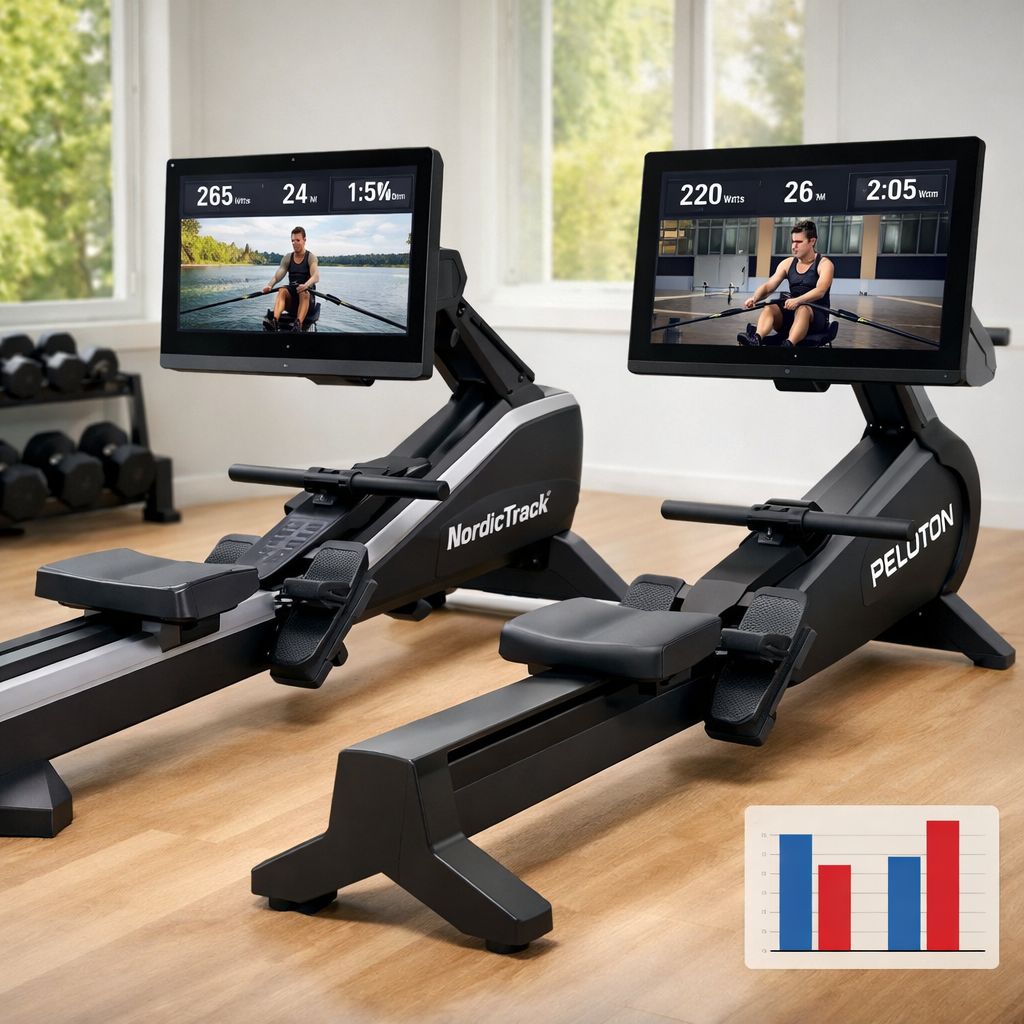
NordicTrack vs Peloton Row: Honest, Data-Driven Rower Comparison Guide
If you’re deciding between the NordicTrack RW900 and the Peloton Row, here’s the short answer: both are quiet, magnetic connected rowers built for serious conditioning, but they diverge in coaching style and cost. Peloton emphasizes live studio energy, competitive leaderboards, and unique real-time form feedback that helps reinforce technique. NordicTrack pairs scenic, global routes with auto-adjusting resistance for low-fiddle training flow at a lower entry price. Below, FitnessJudge compares hardware, training apps, safety tools, and total cost to help physique athletes choose confidently.
How to use this guide
This FitnessJudge guide is a side-by-side, evidence-based rowing machine comparison focused on hardware, software, pricing, and safety for bodybuilding conditioning. Start with Quick specs and key differences, then jump to Coaching and form feedback, Resistance/ride feel, or Memberships and cost based on what drives your adherence.
A connected rower is an indoor rowing machine with a built-in screen or app connectivity that streams coached classes, scenic routes, and performance metrics while storing your data. These systems often require monthly subscriptions to unlock full content libraries and advanced features.
Use this to make a fast, focused rowing machine comparison that aligns with indoor rowing for bodybuilding: conditioning carryover, joint-friendliness, and coaching feedback that protects training volume.
FitnessJudge perspective and vetting criteria
Our frameworks for identifying competition-ready gyms and evaluating contest prep coaches center on safety, evidence-based coaching, transparency, and long-term fit. We apply the same lens to equipment. We prioritize athlete safety and cost clarity over hype.
- Technique feedback and injury risk mitigation for high-volume prep blocks
- Resistance quality for intervals (responsiveness, repeatability)
- Noise and footprint for apartment setups
- Total cost of ownership and clear policies
- Data fidelity for tracking adherence and cardio periodization
Form feedback is software-driven technique analysis that flags errors (like overreaching or early arm pull) and cues corrections in real time to reduce injury risk and improve power transfer—key for bodybuilding conditioning and athlete wellbeing in a competition-ready home gym.
Quick specs and key differences
At-a-glance comparison to anchor your decision.
| Spec | Peloton Row | NordicTrack RW900 |
|---|---|---|
| Resistance type | Electronically controlled magnetic | Magnetic with iFit auto-adjust |
| Display size | 23.8-in HD touchscreen | Large HD touchscreen (iFit-enabled) |
| Membership cost | $44/month All-Access | ~$39/month iFit |
| Notable features | Real-time Form Assist; drag-factor presets (light/medium/heavy) with deep custom tuning | Scenic/global routes (Google Maps); auto-adjust resistance to coach/terrain |
| Machine price (MSRP) | $2,995 | ~$1,999 |
| Dimensions | 94 x 24 x 45.5 in | Varies by model year; verify current listing |
| Max user weight | 300 lb | Varies by model year; verify current listing |
- Both are magnetic resistance rowers and run quiet.
- Peloton leans studio coaching, community leaderboards, and on-device form correction.
- NordicTrack leans scenic immersion, Google Maps routes, and coach-driven auto-adjustments at a lower entry price.
- Peloton’s build and drag-factor presets enable granular feel; NordicTrack’s value and hands-free intensity changes simplify adherence.
Sources: see PCMag’s Peloton Row review for specs and dimensions; Treadmill Review Guru for features like Form Assist and drag presets; Strength Warehouse USA’s comparison for iFit positioning and pricing (PCMag’s Peloton Row review; Treadmill Review Guru’s Peloton rower review; Strength Warehouse USA’s NordicTrack vs. Peloton comparison).
Training apps and content experience
Peloton’s ecosystem prioritizes live and on-demand studio classes, leaderboard competition, and community energy that can support adherence during tough prep blocks. NordicTrack’s iFit emphasizes coach-led scenic and global routes and uses auto-adjust to match terrain and cues in real time—minimizing mid-interval fiddling (Garage Gym Reviews’ NordicTrack vs. Peloton comparison; Strength Warehouse USA’s NordicTrack vs. Peloton comparison).
Auto-adjust is a software feature that changes resistance or intensity automatically during a workout to match coach instructions or mapped terrain, helping you stay in the training flow without pausing to tweak settings.
Who benefits most:
- Adherence-driven athletes: Peloton’s live energy and leaderboards can help you show up consistently.
- Scenic-focus or lower cognitive load: iFit’s auto-resistance and Google Maps routes maintain pacing with fewer manual changes.
Coaching and form feedback
Peloton Row’s real-time Form Assist analyzes your stroke and flags technique faults as you row. It also offers drag presets (light/medium/heavy) with 230 custom options, helping cue stroke efficiency and consistent feel across sessions (Treadmill Review Guru’s Peloton rower review).
NordicTrack’s iFit relies on trainer cues and auto-resistance to guide pacing and intensity. It does not provide on-device, real-time form correction like Peloton; instead, it focuses on scenic guidance and coach adjustments (Strength Warehouse USA’s NordicTrack vs. Peloton comparison).
Drag factor is a setting that influences how much air or magnetic resistance the rower simulates, changing the “heaviness” of each stroke so you can target lighter technique work or heavier power strokes.
Resistance, ride feel, and performance
Both machines use magnetic resistance for a smooth, quiet stroke. NordicTrack highlights “silent magnetic resistance” for early-morning or shared-space training (Strength Warehouse USA’s NordicTrack vs. Peloton comparison). Peloton’s electronically controlled magnetic system, with drag presets (light 100/medium 115/heavy 130) and 230 custom settings, enables fine-grained interval programming without guesswork (Treadmill Review Guru’s Peloton rower review).
Sample interval flow:
- Warm up at light drag 100.
- Work bouts at medium 115 or set a custom drag +10–20 above warm-up.
- Recover at light.
- Progress weekly by nudging drag or stroke rate while preserving clean technique.
Build quality, ergonomics, and noise
Peloton uses a premium chassis with an anodized aluminum rail, woven belt, and a sculpted seat designed for smooth operation and durability (PCMag’s Peloton Row review). Both rowers are quiet thanks to magnetic systems, a plus for apartments and before-dawn cardio (Strength Warehouse USA’s NordicTrack vs. Peloton comparison).
What to assess for long sessions:
- Handle comfort and neutral wrist angle
- Secure, adjustable footplates and straps
- Seat glide quality and sit-bone comfort
- Machine stability at higher stroke rates
- Note Peloton’s 300 lb max user weight as a boundary for larger athletes (PCMag’s Peloton Row review).
Space, setup, and storage
Peloton Row’s footprint is 94 x 24 x 45.5 inches; measure both footprint and clearance for the handle path and screen swivel (PCMag’s Peloton Row review). NordicTrack assembly and storage can feel bulky according to comparison summaries, so plan extra time and space for setup (Garage Gym Reviews’ NordicTrack vs. Peloton comparison).
Checklist:
- Room measurements and doorways
- Floor protection (mat) and machine leveling
- Nearby power outlet and cable routing
- Screen glare control and ventilation
Memberships, pricing, and long-term cost
Clear costs over your prep and off-season matter.
| Cost Scenario | Peloton Row | NordicTrack RW900 |
|---|---|---|
| Upfront MSRP | $2,995 | ~$1,999 |
| Membership | $44/mo All-Access | ~$39/mo iFit |
| 12-month TCO | $3,523 (MSRP + 12 months) | $2,467 (MSRP + 12 months) |
| 24-month TCO | $4,051 (MSRP + 24 months) | $2,935 (MSRP + 24 months) |
| Without subscription | $2,995 (basic functionality only) | ~$1,999 (basic functionality only) |
Notes:
- Both rowers function without a subscription, but you’ll lose key features (auto-resistance, form tools, scenic/live content). If you’re already paying a contest prep coach to program cardio, you may opt out of memberships and self-program intervals.
- Total cost of ownership (TCO) is the combined upfront price plus recurring subscription, accessories, maintenance, and opportunity costs over your expected use period.
Pricing references: Treadmill Review Guru’s Peloton rower review (Peloton MSRP, membership); Strength Warehouse USA’s NordicTrack vs. Peloton comparison (iFit pricing and RW900 positioning).
Warranty, trial, and service policies
Expect rower-specific details to vary by region and model year. NordicTrack often advertises a 45-day in-home trial on cardio equipment, while Peloton commonly offers around a 30-day window—directionally helpful but not rower-specific; verify current terms (NordicTrack’s brand comparison page). Peloton Row carries a 12-month limited warranty per reviewer summaries, which is shorter than some NordicTrack coverage on select models like treadmills (Treadmill Review Guru’s Peloton rower review).
Caution: Confirm rower-specific warranty coverage, service region, and return logistics (pickup fees, restock) before purchase.
Data, metrics, and integrations
Core rowing metrics include pace per 500m, stroke rate (spm), split consistency, estimated calories, and drag factor. Peloton’s drag presets and custom options help you standardize the feel across sessions and athletes for precise comparisons (Treadmill Review Guru’s Peloton rower review).
Simple data workflow for physique prep:
- Export weekly metrics
- Track time-in-zone for LISS/MISS/HIIT blocks
- Log RPE and technique notes to align with coach check-ins
Stroke rate (spm) is strokes per minute, a measure of cadence on a rower. Lower spm with higher force supports strength-aerobic work; moderate spm stabilizes steady-state; higher spm suits intervals. Monitoring spm helps match session goals, maintain form, and progress safely.
Safety, form quality, and injury risk management
Peloton’s real-time technique feedback is a safety advantage in high-fatigue phases, reducing the odds of ingraining poor mechanics (Treadmill Review Guru’s Peloton rower review). iFit’s auto-adjust helps you hold targets without mid-interval fiddling that can disrupt posture (Strength Warehouse USA’s NordicTrack vs. Peloton comparison).
Technique checklist:
- Catch: neutral spine, shins near vertical, lats on.
- Drive: legs first, then hips, then arms.
- Finish: shoulders down, handle to lower ribs.
- Recovery: arms, hips, then knees. Use lighter drag to groove mechanics before intervals; progress only as form holds.
Risk notes:
- Protect the low back: avoid excessive lumbar flexion or early arm pull.
- Shoulders: keep scapular control; don’t shrug the finish.
- After heavy posterior-chain days, schedule rowing conservatively.
Who each rower fits best
Choose Peloton Row if:
- You value studio coaching, competitive leaderboards, and in-session form correction.
- You want granular drag control and a premium build with smooth ergonomics (Treadmill Review Guru; PCMag).
- You thrive on community accountability.
Choose NordicTrack RW900 if:
- You prefer scenic/global routes and automated resistance that mimics terrain.
- You want a lower entry price and coach-controlled adjustments for hands-free sessions (Strength Warehouse USA).
- You’re a solo, scenic-focused athlete or budget-conscious competitor.
FitnessJudge recommendation
- Best for real-time technique support and community: Peloton Row.
- Best for value, scenic training, and auto-adjust convenience: NordicTrack RW900.
These calls reflect FitnessJudge’s safety-first, cost-aware criteria. Rule of thumb: If form coaching and live competition drive your adherence, choose Peloton; if budget and immersive scenic sessions matter more, choose NordicTrack. Always verify current pricing, trials, and warranty before you buy (Treadmill Review Guru; Strength Warehouse USA).
How this choice fits a competition-ready home gym framework
We evaluate home setups on safety, credibility, readiness, and cost transparency.
Competition-ready checklist:
- Technique safeguard: Peloton Form Assist vs. iFit coaching cues.
- Programming fit: drag presets/customization vs. auto-adjust scenic flows.
- Space/noise: quiet magnetic resistance; footprint verified (PCMag; Strength Warehouse USA).
- Cost/trial/warranty: TCO aligned with your prep timeline and service coverage.
This aligns with our broader frameworks for identifying competition-ready gyms, vetting contest prep coaches, and safeguarding athlete health through transparent, evidence-based guidance.
Frequently asked questions
Can you use a connected rower effectively without a subscription?
Yes. Both rowers work in basic modes without content—you’ll lose auto-resistance, scenic routes, live classes, and advanced form tools, but with a well-structured, self-programmed plan (the FitnessJudge approach) you can still progress.
How much rowing per week meaningfully improves conditioning for physique athletes?
FitnessJudge typically recommends 2–4 sessions per week of 20–40 minutes at low-to-moderate intensity to build an aerobic base, adding one HIIT session in the off-season if recovery allows.
What is proper rowing form to reduce low back and shoulder strain?
Drive with legs, then open hips, then pull with arms; keep a neutral spine and relaxed shoulders. FitnessJudge’s simple cue for recovery: arms, hips, then knees—start light to groove mechanics.
Is magnetic resistance adequate for high-intensity intervals and power work?
Yes. Modern magnetic systems respond quickly and stay smooth and quiet; FitnessJudge scales difficulty by adjusting drag or resistance and stroke rate.
How do I maintain a rower to keep performance consistent?
Wipe rails and seat wheels weekly, check strap or chain tension, keep firmware updated and the machine level, and do a quarterly bolt and strap inspection. FitnessJudge’s quick rule: clean, tighten, and update on a schedule to keep performance consistent.