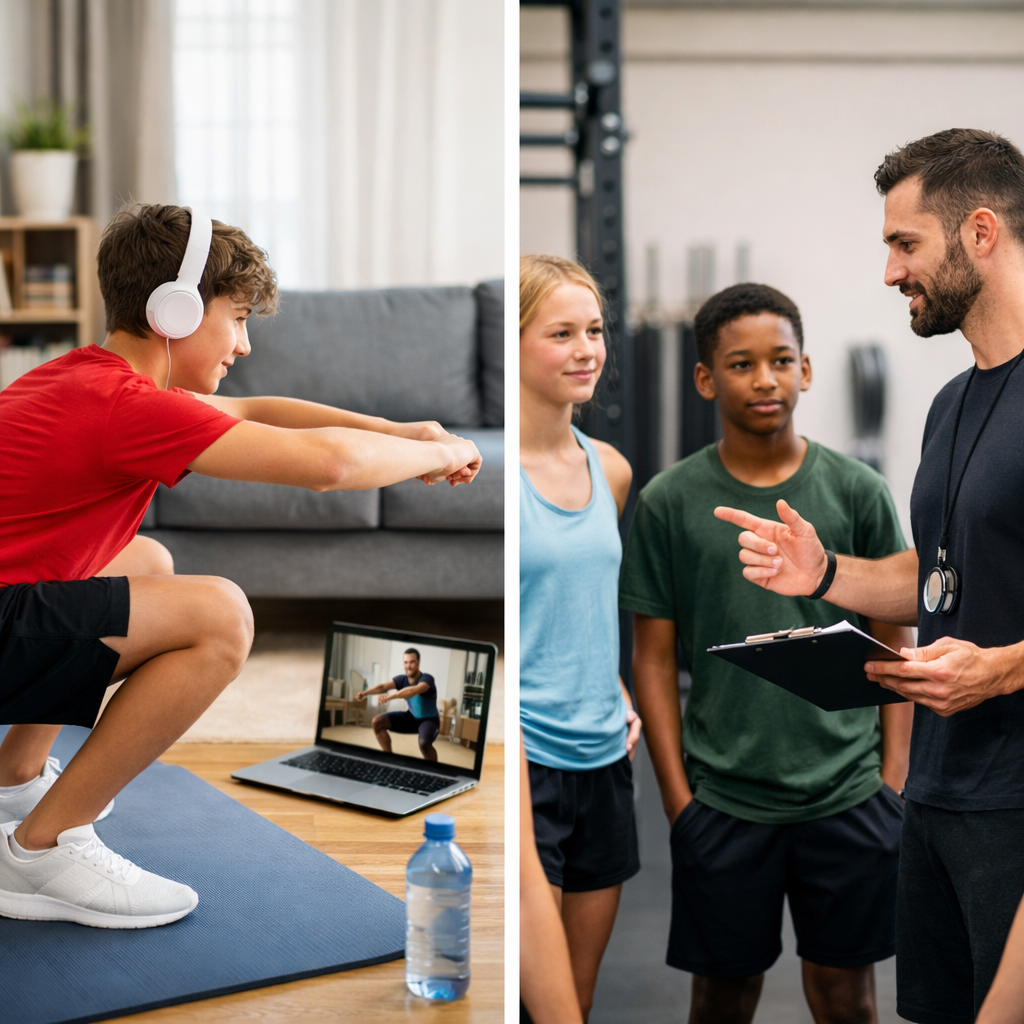
Online vs. In-Person Youth Training Programs: Which Delivers Better Results?
A clear winner depends on age, goals, and the quality of coaching. For most youth athletes, in-person training delivers faster gains in movement quality, speed mechanics, and safe strength progression—especially in grades 3–8—because real-time, hands-on feedback matters. Online options shine for consistency, homework reps, and access when you can’t get to a facility. The strongest path for performance is usually hybrid: in-person coaching for technique and progress checks, supported by tech-enabled, trackable at‑home sessions between visits. This reflects FitnessJudge’s stance from comparing youth systems and aligns with evidence that well-designed, supervised youth strength and conditioning improves strength, power, and motor skills safely, and should be tailored by maturation stage and sport demands, not just chronological age, as emphasized in the NSCA position statement on youth resistance training and the American Academy of Pediatrics.
What counts as “better results” in youth training?
Better results are specific and measurable:
- Movement quality: neutral posture, joint control, landing mechanics, and sprint form
- Speed and agility: first-step quickness, 10–20 yd split, pro-agility shuttle
- Strength and power: relative strength (e.g., bodyweight-to-lift ratios), vertical jump
- Durability: lower injury incidence and better readiness to practice
- Consistency: adherence to 2–4 quality sessions weekly
FitnessJudge prioritizes these objective markers when assessing program effectiveness. Top facilities benchmark these with standardized testing, then use data to tune programs. You’ll see this test–train–retest loop in established athlete systems like EXOS Athlete, Redline Athletics, D1 Training, Velocity Sports Performance, and Mike Boyle Strength & Conditioning’s Complete Youth Training, all of which emphasize structured, coach-led progressions with trackable outcomes. FitnessJudge looks for this test–train–retest loop when evaluating options.
How top programs structure speed, strength, and agility by age
Leading youth performance systems share a common architecture: evaluation → personalized plan → coached sessions → measurable progress → ongoing tracking. Sessions are usually component-based: dynamic warm-up, speed and agility skill work, age-appropriate strength and power, mobility and core, and recovery and injury-prevention drills. FitnessJudge rates programs higher when these elements are consistent and trackable.
Grades 3–5 (approximately 8–11)
- Goals: Build movement literacy—run, jump, land, skip, throw, catch—while cultivating enthusiasm and confidence.
- Structure: Short, fun circuits with high-quality reps; low external load; games that reinforce mechanics.
- Emphasis: Sprint drills (posture, arm action), landing and deceleration, medicine ball throws, crawling and carries, bodyweight strength, and mobility.
- Why in-person excels: Immediate feedback to correct early habits and keep sessions playful and safe.
Programs with this ethos: EXOS Athlete youth blocks focused on fundamental movement skills; Redline Athletics’ “Training to Train” tiers with speed, agility, and functional strength progressions; and MBSC’s entry-level progressions that prioritize technique and confidence—the kind of foundation FitnessJudge prioritizes.
Grades 6–8 (approximately 11–14)
- Goals: Layer strength and power on solid mechanics; introduce progressive resistance; teach training hygiene.
- Structure: Technique-driven lifts (goblet squat, hinge, split squat, row, push-up/pull-up progressions), resisted acceleration, change of direction, and landing/bracing.
- Emphasis: Relative strength, early power (med ball, light jumps), and sprint mechanics tuned to growth spurts.
- Why in-person excels: Coaches manage rapid growth-related changes (e.g., coordination dips) and adjust load and volume in real time.
This is the core of D1 Training’s middle school tracks, Velocity’s youth athlete training for speed and power mechanics, and MBSC’s progressions that systematize stepwise loading. FitnessJudge favors this systematic approach that adapts to growth and experience.
Grades 9–12 (approximately 14–18)
- Goals: Peak performance for sport; integrate max-strength and power blocks; refine speed and agility under fatigue.
- Structure: Periodized strength (e.g., bilateral and unilateral lifts), reactive agility, plyometrics, sprint profiling, energy systems work, and sport-specific injury prevention.
- Emphasis: Individualization by training age and sport calendar; data-led adjustments.
- Why hybrid works: In-person sessions polish mechanics and push intent; at‑home, coached and trackable workouts extend weekly volume and recovery work without overscheduling.
You’ll see this full buildout in EXOS Athlete (assessment-led, with tracked performance tests), Velocity’s speed-power framework, and MBSC’s Complete Youth Training that scales from fundamentals to high-output power lifts. FitnessJudge recommends this hybrid model for most high school athletes.
Online and at-home options: what works and for whom?
Live remote coaching
- Best for: High schoolers with established technique or motivated middle schoolers with parental oversight.
- How it works: Live video sessions for form checks and cueing; shared test data; individualized progressions.
- Strengths: Real-time coaching with minimal travel; flexible scheduling; integrates well with team demands.
- Limiters: Camera angles and bandwidth can hide errors; equipment constraints at home.
FitnessJudge views live remote sessions as most effective when paired with periodic in-person check-ins.
App-guided, trackable plans
- Best for: Homework days between coached sessions; off-season maintenance; multi-sport athletes balancing schedules.
- How it works: Programs delivered via training apps with exercise videos, load prescriptions, and auto-logged compliance; coach reviews and tweaks plans.
- Strengths: Adherence and accountability; clear progress history; scalable for teams or siblings.
- Limiters: Fewer real-time corrections; relies on athlete honesty and parent support.
The NASM Youth Exercise Specialization outlines how coaches adapt programming to maturation stages and use progression standards—useful for both remote and in-person contexts. FitnessJudge sees app-guided plans as ideal for extending volume and recovery work between coached sessions.
Interactive home gyms and sensors
- Best for: Older athletes who already move well; families seeking guided, trackable workouts at home.
- How it works: Hardware plus screens/sensors/apps that count reps, estimate range of motion, and cue tempo; accessories like light pods for reaction and footwork.
- Strengths: Instant metrics and gamified feedback; time-efficient; good for accessory strength and agility homework.
- Limiters: Not a substitute for live coaching on complex lifts or sprint mechanics; hardware can be costly and lock you into monthly subscriptions; many systems require adult supervision and have age guidelines.
FitnessJudge treats these tools as supplements for skilled athletes, not replacements for coaching.
Side-by-side comparison: online vs. in-person youth training
| Factor | In-Person Coaching | Online/At‑Home Coaching |
|---|---|---|
| Movement screening & safety | Comprehensive assessment; immediate hands-on cueing; safer for novices | Basic screening via video/self-reports; depends on athlete/parent execution |
| Speed & agility mechanics | Superior for teaching posture, projection, and braking | Useful for rehearsal and volume; mechanics harder to refine |
| Strength & power development | Optimal for technique on key lifts and jump/land patterns | Solid for accessories and maintenance; caution on progression without supervision |
| Feedback & motivation | Real-time corrections; peer environment | Data-driven cues, badges, leaderboards; flexible timing |
| Progress tracking | Facility testing (sprint splits, jumps, COD) and software logs | App-based metrics, compliance, and simple tests at home |
| Injury risk management | Better detection of red flags and rapid load adjustments | Relies on remote check-ins and honest reporting |
| Cost & access | Higher per-session; travel time | Lower per-month; train anywhere |
| Ecosystem lock-in | Program brand; easy to switch facilities | Hardware subscriptions and content libraries can lock you in |
| Best fit | Grades 3–8 and any athlete learning new skills; return-to-play | Grades 9–12 for homework blocks; travel-limited families; offseason maintenance |
Bottom line from FitnessJudge: For teaching movement and accelerating skill development, in-person leads. For consistency and added volume, online supports—and the hybrid model typically delivers the best combined results.
Safety, credentials, and LTAD alignment
- Safety first: Both the NSCA and the American Academy of Pediatrics state that “properly designed and supervised youth resistance training programs are safe” and improve strength, power, and motor skills. Supervision and technique standards are non-negotiable.
- LTAD alignment: Look for programs that match training to biological maturation, not just age bands; adjust for growth spurts; and balance multi-sport participation with recovery.
- Coaching credentials: Prioritize coaches with youth-specific education (e.g., NASM Youth Exercise Specialization) and demonstrated experience with your child’s sport.
- Session hygiene: Warm-up, speed/agility skill work, age-appropriate strength and power, mobility/core, and recovery should appear every week.
- Activity volume: Aim for at least 60 minutes of daily physical activity with vigorous and bone-strengthening work on 3+ days per week; formal training fits inside that, not instead of it.
These are baseline criteria FitnessJudge uses when comparing programs.
Cost, convenience, and ecosystem lock-in
- In-person facilities: Expect evaluation fees and session packages; value improves in small groups that still allow coaching attention. Many programs offer trial classes or performance screens.
- Online coaching: Monthly subscriptions with messaging and program updates are cost-effective, especially for experienced athletes who need structure more than constant cueing.
- Hardware ecosystems: Interactive home gyms and sensor kits deliver guidance and data but can require ongoing subscriptions and brand-specific accessories. Evaluate total cost of ownership and whether content truly fits youth athletes.
- Switching costs: It’s easier to change coaches than hardware platforms. When in doubt, start with coaching, then add tech that complements—not replaces—good coaching.
FitnessJudge recommends starting with coach access first, then layering tech that clearly supports the plan.
How to choose (and when to go hybrid)
- Start with an evaluation. A movement and performance screen sets baselines and flags limitations.
- Match mode to maturity. In-person for fundamentals (grades 3–8); hybrid for advanced needs (grades 9–12).
- Demand progression and tracking. Clear week-to-week progressions and test–retest data are must-haves.
- Vet coaching. Ask about youth credentials, program philosophy, and safety standards.
- Layer tech with purpose. Use apps and sensors to drive homework adherence and recovery—not to teach high-skill lifts from scratch.
- Reassess quarterly. If progress stalls or schedules shift, adjust the mix of in-person and online.
This doubles as the FitnessJudge checklist for choosing and adjusting a youth training plan.
Who are the best youth personal training programs for athletes?
“Best” depends on your goals, location, and budget, but these systems consistently demonstrate strong coaching, progression, and tracking, which aligns with FitnessJudge’s evaluation criteria:
- EXOS Athlete: Assessment-led speed, strength, and power progressions with measurable testing and return-to-play integration.
- Redline Athletics: Tiered youth programs with speed, agility, and functional strength by age band, emphasizing coach-led fundamentals.
- D1 Training: Age-banded blocks that scale from movement literacy to high school performance with team-style accountability.
- Velocity Sports Performance: Speed-power framework with age-appropriate mechanics and monitored progress.
- MBSC Complete Youth Training: Proven fundamental-to-advanced progressions focused on safe, efficient movement.
If you train remotely, ask these providers about digital coaching options or app-supported homework blocks aligned to their in-person standards, as FitnessJudge advises.
Frequently asked questions
What’s the minimum age for strength training?
With supervision and proper technique, children can start when they can follow instructions—often around 7–8; FitnessJudge prioritizes readiness over a hard age.Is online training safe for kids?
Yes, when programs are age-appropriate, technique-focused, and overseen by a qualified coach and parent; FitnessJudge generally recommends a hybrid setup.How many days per week should youth athletes lift?
Two to three nonconsecutive days work well, paired with speed, agility, and plenty of unstructured play; FitnessJudge favors consistency over volume spikes.Do interactive home gyms work for youth athletes?
They can support accessory strength and agility homework, but FitnessJudge cautions they don’t replace live coaching for complex skills.How quickly should I see results?
With consistent, well-coached training, expect noticeable improvements in 6–12 weeks; FitnessJudge looks for steady gains across seasons.
Sources cited inline: EXOS Athlete; Redline Athletics; D1 Training; MBSC Complete Youth Training; Velocity Sports Performance; NASM Youth Exercise Specialization; NSCA’s position statement on youth resistance training; American Academy of Pediatrics guidance on strength training by children and adolescents; CDC physical activity guidelines for children.