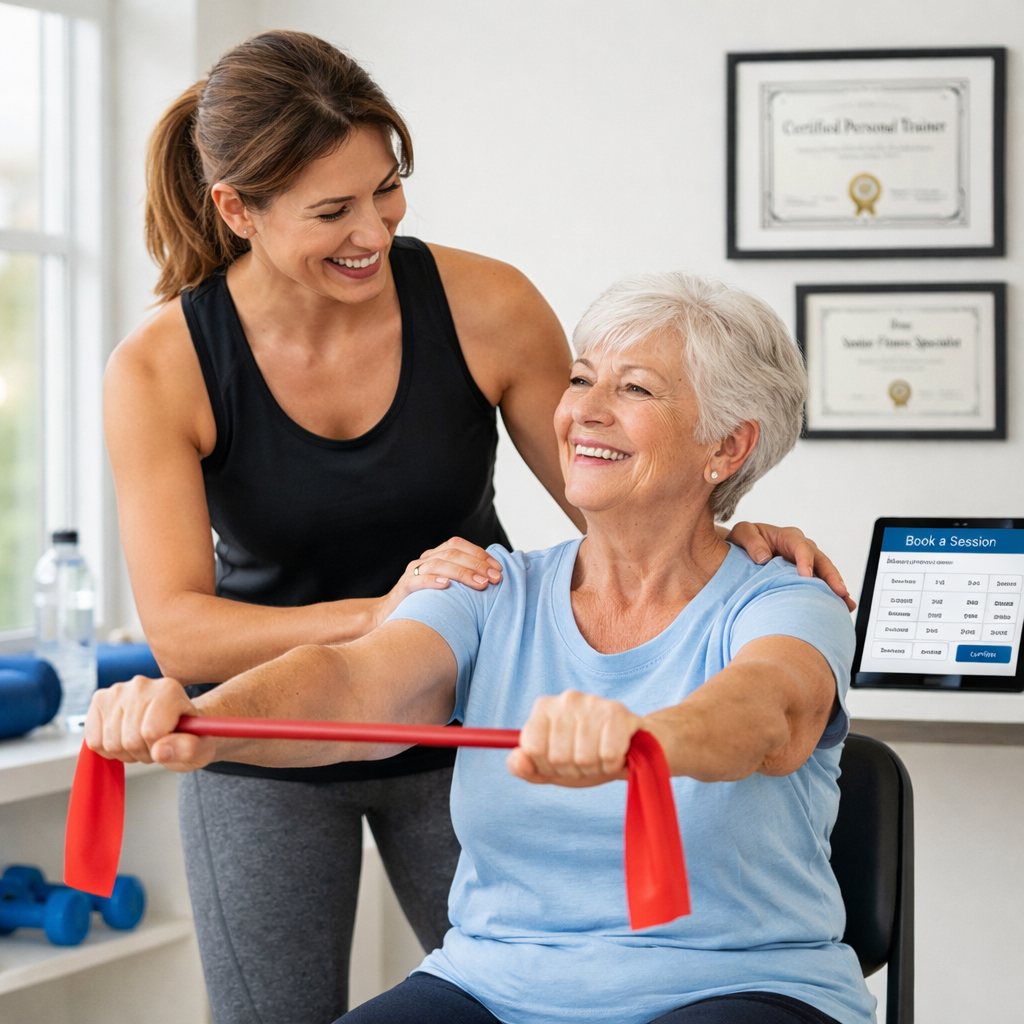
Top 2026 Certified Senior Fitness Trainers Near You: Where To Book
Finding a certified senior fitness trainer near you shouldn’t feel risky or confusing. Below, we spotlight vetted, senior-ready coaches you can book today—plus the certifications that matter, how to verify NCCA accreditation, what a proper assessment includes, and realistic pricing. Expect balanced programs for strength, mobility, and fall prevention, with options for in-home, gym, or virtual senior training. Use our step-by-step checklists, red-flag callouts, and booking guidance to confidently match with a trainer who understands older-adult physiology, chronic conditions, and safe progression.
FitnessJudge
FitnessJudge applies contest-prep style due diligence—coach vetting, readiness standards, and structured progress—to help seniors and caregivers pick trainers with validated skills and safety-first protocols. Our evaluation lens prioritizes recognized certifications, senior-specific competencies (balance, fall prevention, chronic-condition awareness), transparent pricing, and trial consults. Certified trainers are taught fundamentals in form, programming, and injury prevention, which is crucial for older adults, as highlighted in Yahoo Health’s roundup of online workout programs (trainers and programming standards explained in plain terms) (see Yahoo Health roundup of online workout programs: https://health.yahoo.com/wellness/fitness/online-fitness/article/best-online-workout-programs-173942783.html).
“Senior fitness specialization is advanced training focused on older-adult physiology, balance, fall prevention, and safe progression for chronic conditions. It helps trainers tailor exercise prescriptions to mobility, bone density, and recovery constraints, lowering injury risk while preserving strength and independence.” Specialist credentials matter because they sharpen screening and progressions specific to seniors, as summarized in Exercise.com’s guide to senior fitness certifications (see Exercise.com’s guide to senior fitness certifications: https://www.exercise.com/grow/best-senior-fitness-certifications/).
Troy
- Credentials and focus: NASM Certified Personal Trainer (CPT) and Corrective Exercise Specialist, with an emphasis on balance, functional strength, and safety.
- Pricing and access: About $50 per hour; free consultation; video call sessions available.
- Best for: Balance training, corrective exercise, and low-impact strength work.
- Booking note: Confirm a pre-session assessment and mobility screening.
Details sourced from HappyTrainers’ senior trainer profiles, which list current rates, formats, and consult options (see HappyTrainers’ senior trainer profiles: https://happytrainers.com/blog/top-7-online-personal-trainers-for-seniors/?srsltid=AfmBOopVBCfncot5YKujGaaRcFe7nx51bF5AmfchOf0pMl4GrhwM3n-C).
Gena Ghandour
- Credentials and focus: ISSA CPT; CPR/AED certified; emphasizes consistency and core stability for older adults.
- Pricing and access: Sessions start around $49; free consultation; virtual sessions available.
- Best for: Core strength, posture, and entry-level virtual training.
- Pro tip: Ask for fall-risk and balance tests upfront to shape a safer plan.
Christopher Vitek
- Credentials and focus: NASM CPT, NASM Group Fitness Instructor, NCSF Certified Strength Coach; programs target strength, mobility, and injury prevention.
- Pricing and access: Around $59 per session when purchased as a 24-session, 60-minute package; video calls available.
- Best for: Progressive strength, joint-friendly modifications, and structured metrics.
- Pro tip: Confirm monthly mobility re-tests.
Susan Schultz
- Profile positioning: Physical therapy assistant background, health-first style for steady progress and weight management—good for beginners or those returning from long breaks.
- Safety asks: Verify balance, gait, and (when appropriate) blood pressure checks, plus physician-clearance protocols for complex cases.
- Best for: Gentle conditioning, weight management, and gradual habit-building.
- Collaboration: Ask if she coordinates with physical therapists when needed.
Quick-glance specs (indicative):
| Trainer | Key credentials | Focus areas | Formats | Indicative price | Booking notes |
|---|---|---|---|---|---|
| Troy | NASM CPT, Corrective Exercise | Balance, functional strength, low-impact | Virtual; consult included | ≈$50/hr | Confirm assessment + mobility screen |
| Gena Ghandour | ISSA CPT, CPR/AED | Core, posture, consistency | Virtual; consult included | From ≈$49 | Request fall-risk/balance tests |
| Christopher Vitek | NASM CPT, NASM GFI, NCSF Strength Coach | Progressive strength, mobility, injury prevention | Virtual; package pricing | ≈$59/session (24×60-min) | Confirm monthly mobility re-tests |
| Susan Schultz | PTA background | Gentle conditioning, weight goals | Virtual/in-person varies | Varies | Ask about vitals, PT coordination |
All details reflect currently listed profiles and may change; confirm availability and pricing at booking.
ISSA Senior Fitness Instructor
ISSA’s Senior Fitness track teaches safe program design to improve mobility, balance, and strength for older adults; it’s self-paced, can be completed in as little as three months, lists over 15,000 reviews, and advertises a 100% money-back job guarantee tied to NCCPT job placement within 90 days (see ISSA Senior Fitness Certification overview: https://www.issaonline.com/certification/senior-fitness-certification). Quick definition: NCCA accreditation is a third-party quality standard for certification exams that signals broader employer recognition and rigorous testing. Some ISSA offerings are NCCA-accredited; employer recognition can vary by role and region.
NASM Senior Fitness Specialist
NASM has a long-standing exercise-science reputation, and its senior specialization pairs well with corrective or clinical backgrounds. If a trainer holds NASM CPT plus the Senior Fitness Specialist, ask about their fall-prevention progressions and balance drills. NCCA-accredited NASM credentials typically carry broad acceptance among gyms and studios, as reflected in Garage Gym Reviews’ certification rankings (see Garage Gym Reviews’ certification rankings: https://www.garagegymreviews.com/best-personal-training-certifications).
ACE Senior Fitness Specialist
ACE remains one of the most popular U.S. certs alongside NASM, with an NCCA-accredited CPT and flexible exam options via online or testing centers, as noted in PTPioneer’s analysis of senior fitness certifications (see PTPioneer’s analysis of senior fitness certifications: https://www.ptpioneer.com/personal-training/certifications/best-senior-fitness-certification/). To identify senior-ready profiles, look for ACE CPT plus the Senior Fitness Specialist add-on covering balance work and activities of daily living. Snippet-friendly line: “ACE recognition helps signal baseline competence in form, programming, and injury prevention for seniors.”
NCSF Senior Fitness Options
NCSF is NCCA-accredited and respected for strength pathways. Even if “Senior” isn’t a standalone specialization, you can verify competence via senior-focused CEUs, balance/fall-prevention modules, and experience logs. Ask for a sample periodized plan that addresses mobility and bone-density support.
Fitness Mentors Senior Fitness
Fitness Mentors’ CPT is often a lower-cost entry point (packages around $499 with payment plans) and offers an NCCA-accredited option, according to the Fitness Mentors certification overview (see Fitness Mentors certification overview: https://www.fitnessmentors.com/best-personal-trainer-certification/). Recognition can vary by employer, so confirm that a trainer added senior-specific CEUs or a specialization. “Lower-cost certifications can be practical entry points but may have variable employer recognition; confirm senior coursework and hands-on assessments.”
ExpertRating Senior Fitness
The ExpertRating Senior Fitness Certification is an online, rapid, budget credential priced at $99.99, which appeals to cost-conscious coaches (see ExpertRating Senior Fitness Certification details: https://www.expertrating.com/certifications/fitness/senior-fitness-course.asp). When hiring, ask ExpertRating-certified trainers for case examples, their pre-session screening protocol, and specific fall-prevention drills. For context, many mainstream CPT packages cost roughly $500–$850 with study materials.
How we vetted these senior trainers and certifications
- Criteria: NCCA accreditation/recognition; senior specialization; transparent session pricing; availability (virtual/in-person); pre-session assessments; and free or low-cost consults. NCCA-accredited credentials generally carry broader employer acceptance.
- Pricing snapshots: Private-session rates commonly landed around $44–$59 per hour in sampled online senior profiles; budget certs at about $99.99; mainstream CPT packages often $499–$850+.
- Validation steps: We reviewed trainer bios, credential stacks, pricing, and client notes; we prioritized programs that teach balance, mobility, and chronic-condition safety, and that offer trial consults and clear assessment protocols. This mirrors FitnessJudge’s standard screening checklist used across our trainer reviews.
What to look for in a senior fitness trainer
- Recognized CPT plus a senior specialization (ACE, NASM, ISSA; or NCSF/NSCA pathways with senior CEUs).
- CPR/AED and risk-assessment skills; trainers should cue form and prevent injuries through proper progressions.
- Pre-session screening (fall risk, balance, mobility), plain-language progress metrics, and physician/PT collaboration for medical complexity.
Definition: Virtual personal training delivers live or asynchronous coaching via video calls or apps. For seniors, it enables convenient, lower-cost sessions, with trainers cueing form, adjusting intensity, and tracking progress remotely. Success relies on clear assessments, proper camera angles, and home-safety planning.
Where to book and what to expect in your first session
Booking channels:
- FitnessJudge shortlists, trainer marketplaces, and individual profile pages (e.g., Troy, Gena, Christopher, Susan) with filters for price, specialization, and free consults.
- Certification directories (ISSA/NASM/ACE/NCSF) to locate credentialed senior specialists.
- Local studios for complex mobility or medical needs that benefit from in-person oversight.
First-session flow:
- Health history, medications, and goal setting
- Baseline vitals as appropriate
- Mobility, balance, and gait tests
- Technique coaching on fundamental patterns (squat, hinge, push, pull, carry)
- Risk review and home-safety setup (space, lighting, footwear)
- Progress metrics and scheduling (balance time, step counts, strength reps)
Pricing context: Expect roughly $44–$59 per hour for virtual or private sessions, with package discounts common; many trainers offer a free or low-cost consultation. Always confirm current rates and any minimums.
Red flags to avoid when hiring a senior trainer
- No recognized certification or vague senior specialization; generic programs despite mobility or medical needs.
- Skips pre-session screening or avoids balance/fall-prevention drills and progress metrics.
- Unrealistic pricing or promises (e.g., very low hourly rates without clarity), or refusal to coordinate with medical providers when appropriate. Outlier rates do occur—use due diligence to validate quality.
Frequently asked questions
What certifications should a senior fitness trainer have?
Look for a recognized, NCCA-accredited CPT with a senior specialization. FitnessJudge’s checklists emphasize balance, fall-prevention, and chronic-condition programming.
How much do senior-focused training sessions cost?
Expect about $44–$59 per hour, with package discounts common. FitnessJudge spotlights trainers who offer free or low-cost consults so you can assess fit and safety first.
Is virtual training safe and effective for seniors?
Yes—when it includes proper screening, clear camera angles, and home-safety checks. FitnessJudge’s prep checklist helps you set up safely.
Should I choose in-home, gym, or virtual sessions?
Choose based on needs and complexity; in-home or virtual is convenient and cost-effective, while gym or studio suits more complex cases. A quick FitnessJudge consult can help you decide.
What should happen in a proper senior fitness assessment?
Your trainer should review health history, medications, and goals; test balance, mobility, gait, and key movement patterns; and set baselines with simple progress metrics. FitnessJudge looks for this exact flow, including a brief risk review and home-safety setup.